Fully Clad vs Disc Bottom Stainless Cookware
Where the aluminum or copper core sits changes heat spread, sidewall cooking and warp risk. Learn the trade-offs before you pick a stainless set.
 By BuyOnceChoice Editorial Team
Updated November 16, 2026
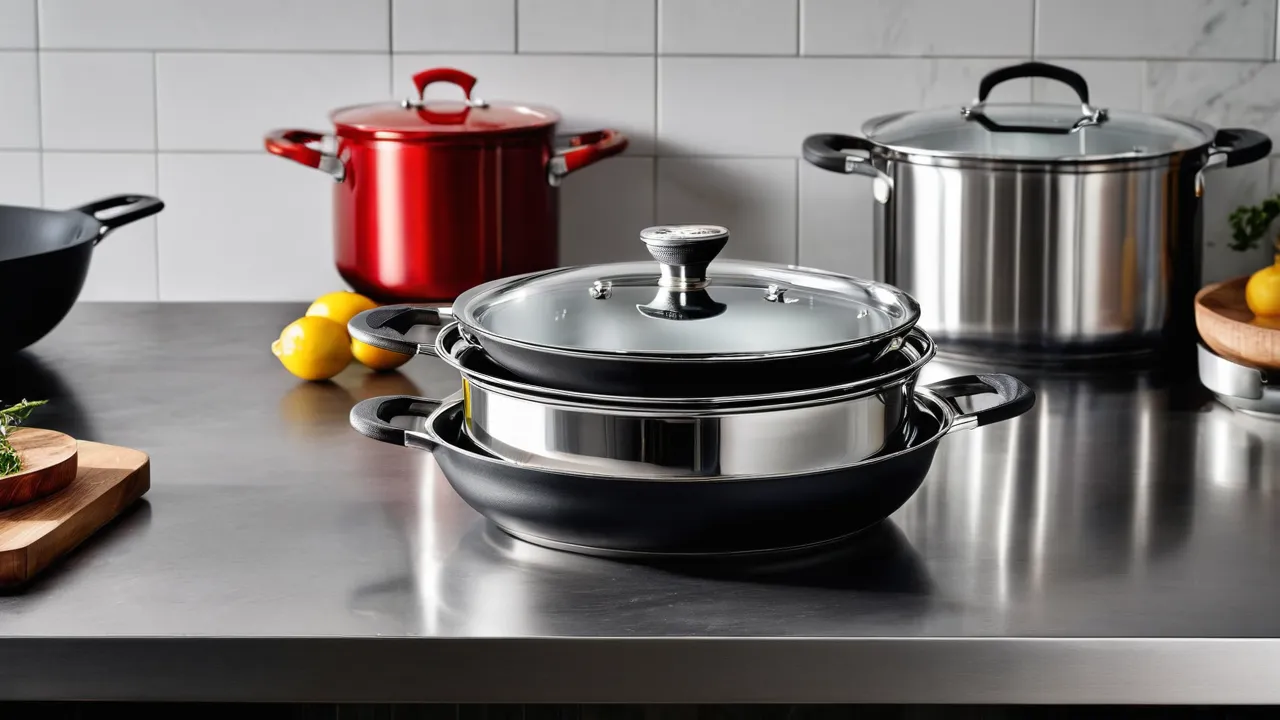
Fully clad stainless cookware has layers of metal running from the base up the sidewalls, while disc-bottom cookware has a thick aluminum or copper disc bonded only to the base. Fully clad pans heat more evenly up the sides and resist warping, and disc-bottom pans cost less and can be lighter. Choose fully clad for saucepans, sauté pans and anything with liquid, and consider disc-bottom for stockpots and budget buys.
How Each Construction Works
In a fully clad pan, sheets of metal are bonded together into a layered sandwich, usually stainless steel on the inside, an aluminum or copper core in the middle and stainless or magnetic steel on the outside. The sandwich is then formed into a pan, so the layers cover both the base and the walls.
In a disc-bottom pan, the body is a single layer of stainless steel, and a thick disc or plate of aluminum or copper, often capped with steel, is bonded to the bottom. The sidewalls are plain stainless. Disc-bottom is also called impact-bonded or encapsulated base in some product descriptions.
The difference matters mostly for where heat goes. Our stainless steel cookware page explains the metals, and this article focuses on the two builds.
Heat Behavior on the Stove
A burner heats the base of a pan. In a fully clad pan, the aluminum core carries heat up the walls, so the sidewalls get warm too. That helps when you simmer a sauce, reduce a liquid or sauté with food touching the sides, because the whole interior heats evenly, and it reduces scorching at the edges.
In a disc-bottom pan, heat spreads across the base through the disc, but the walls stay cooler, since stainless conducts heat poorly. The base is hot and even, and the sides are warm at best. For boiling water or cooking pasta, this makes no difference, since the water carries heat. For a sauté or a reduction, the cooler walls can mean uneven results near the edges.
Response to heat changes also differs. Thick discs hold heat and respond slowly, and clad pans, depending on thickness, tend to respond a little more quickly. Total thickness and the amount of aluminum matter more than the label. A thick disc can outperform a thin clad pan on the base, and a thin disc can create hot spots.
Warping, Wobble and Durability
Fully clad construction resists warping, because the layers are bonded through the whole pan and expand and contract together. Disc-bottom pans are more prone to a particular issue: the disc and the body can expand at different rates, which in cheap pans can lead to a bulging or concave base, or in rare cases separation of the disc. A pan that rocks on a flat surface or spins on a burner is warped.
Quality varies, and a well-made disc-bottom pan can last decades. Look for a disc that is thick and fully bonded to the base, and a rim that is formed cleanly. Avoid sudden temperature changes, such as putting a hot pan under cold water, since thermal shock can warp any pan. Check the warranty for what it covers, including base warping and disc separation.
Both can be dishwasher safe according to the maker, but hand washing keeps stainless looking better. Avoid harsh abrasives, and let the pan cool before cleaning.
Induction, Weight and Price
Induction needs a magnetic base. Fully clad pans with a magnetic outer layer work on induction. Disc-bottom pans work if the disc is capped with magnetic stainless steel or the pan is labeled induction compatible. Check for the induction mark, and use a magnet on the bottom, which should stick firmly. Induction heats the base directly, so sidewalls of a disc-bottom pan may be cool, and the heat is concentrated on the base.
Weight varies. Fully clad pans are often heavier, because the layers run through the whole pan, though a thin clad pan can be light. Disc-bottom pans can be lighter, particularly in large pots, which makes a big stockpot easier to lift.
Price follows construction. Fully clad cookware generally costs more, since the cladding process is more complex. Disc-bottom is generally cheaper, and a good choice when you want a large pot without the cost. Compare the thickness and weight, and avoid assuming that the label alone tells you the price is fair.
Where Each Type Makes Sense
- Saucepans and sauté pans: fully clad, since sides touch food and heat evenly.
- Skillets: fully clad for even searing across the base and up the sides, or a thick disc if the base is substantial.
- Stockpots and pasta pots: disc-bottom is often fine and lighter, since liquid carries the heat.
- Budget buyers: a disc-bottom set can be a good value, if the disc is thick and flat.
- Cooks who simmer sauces and reduce liquids: fully clad.
- Cooks who boil more than they sauté: disc-bottom works.
- Cooks who need light weight for large pots: disc-bottom.
A Worked Example
A cook buys a disc-bottom saucepan to make a tomato sauce. The sauce bubbles hard at the base and sticks there, while the sides stay cool and the sauce along the walls barely moves. The cook must stir often and keep the heat low. A fully clad saucepan of the same size heats the whole interior, so the sauce simmers evenly and sticks less. For boiling pasta, the same cook finds the disc-bottom pot works just fine, and is lighter to lift. The cook ends up with a fully clad saucepan and skillet for sauces and sautéing, and a disc-bottom stockpot for boiling. The mix fits the jobs.
Care, Cleaning and Everyday Habits
Stainless cookware of both builds benefits from the same habits. Preheat the pan over medium heat before adding oil, so food releases cleanly. Avoid high heat for routine cooking, since it causes discoloration and can stress the bond between layers. Let the pan cool before washing. Soak stuck-on food in warm water, and use a non-scratch scrubber or a paste of baking soda for stains. Rainbow heat tint can be removed with a mild acid such as diluted vinegar. Dry the pan to avoid water spots.
One habit that suits disc-bottom pans in particular is gentle handling of the base. A disc can loosen if the pan is struck against a hard edge, so do not bang it on the stove grate or the counter. For fully clad pans, check the rim for visible layers and keep it clean, since trapped food in the rim edge can corrode. Both builds last longer when they are stored without stacking heavy objects on top.
Think about the lifespan you expect. A fully clad skillet and saucepan used weekly can serve for decades. A disc-bottom stockpot used to boil pasta can last just as long, and its simple build makes it hard to damage. The mix of builds is often the best choice, because it puts money where heat distribution matters and saves it where it does not. Check how your warranty treats each piece, and keep receipts for the ones you use most.
A final practical tip: if you cannot tell which build a pan has from the product page, look at the pan itself or the photos. Turn the pan over and look at the rim. In a fully clad pan, you can often see thin layered lines along the rim of the wall. In a disc-bottom pan, you see a plain single layer of steel on the wall and a visible step or ring where the base plate attaches. A tap on the wall also tells a story: a clad wall sounds dull and solid, and a single-layer wall rings more. These small checks help when descriptions are vague.
What to Check Before Buying
- Look at the product page for the construction: fully clad, disc bottom, encapsulated or impact bonded.
- Check the base thickness or weight of the pan, if listed.
- Look for an induction mark if you have an induction cooktop, and check that a magnet sticks.
- Check that the pan sits flat on a counter.
- Read the warranty, in particular what it says about warping and disc separation.
- Check the handle, lid and oven safe temperature.
- Compare the same size in each construction by weight and price.
If a page says only “stainless steel cookware,” ask for the details. For how we weigh such claims, see how we review, and browse the cookware and kitchen tools hub for related guides.
Frequently Asked Questions
Is fully clad cookware better than disc bottom?
For sauces, sautéing and simmering, fully clad heats the sides as well as the base and resists warping, so it is usually better. For boiling and large pots, disc-bottom works well and can be lighter and cheaper. Choose by task.
Does disc-bottom cookware work on induction?
Often yes, if the base disc is capped with magnetic stainless steel or the pan is labeled induction compatible. Check the product page and use a magnet on the bottom. Without a magnetic layer, the pan will not heat on induction.
Can a disc-bottom pan warp?
It can, particularly if it is thin or if it goes through sudden temperature changes. A thick, well-bonded disc is more durable. Check that the pan sits flat when you buy, and avoid putting a hot pan under cold water.
Why does food stick at the edges of my pan?
In a disc-bottom pan, the walls are cooler than the base, so food at the sides can behave differently. Preheat the pan, use enough fat and stir. A fully clad pan heats the sides more evenly, which can reduce sticking.
Final Thoughts
Choose fully clad for saucepans, sauté pans and skillets where even heat matters, and disc-bottom for large boiling pots and budget purchases. Check thickness, flatness, induction compatibility and the warranty, and match the construction to what you cook most.
Related buying guides
- Gas vs Electric vs Induction: Which Cookware Works
- Hard Anodized vs Stainless Steel Cookware
- How Long Do Nonstick Pans Last, and When to Replace
About the author

The BuyOnceChoice Editorial Team researches durable products worth buying once. Our guides compare published specifications, warranty terms, expert review consensus, and verified owner feedback. We do not conduct our own product trials. See How We Review and our Editorial Policy for our standards.